
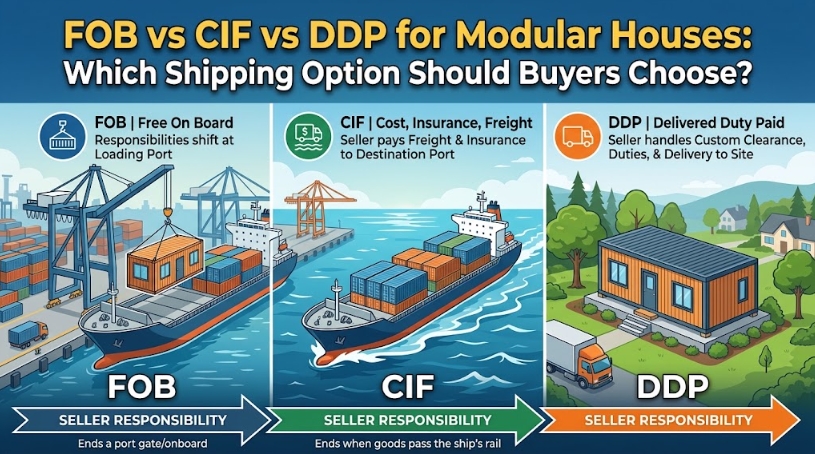
When procuring modular buildings, container houses, expandable units, or prefabricated structures internationally, selecting the right shipping term is as critical as choosing the building specification. In international trade, Incoterms® (International Commercial Terms) published by the International Chamber of Commerce (ICC) define the precise division of costs, risks, and operational responsibilities between buyer and seller.
For property developers, resort operators, and construction managers, comparing factory quotations requires understanding whether a price is quoted as FOB (Free on Board), CIF (Cost, Insurance, and Freight), or DDP (Delivered Duty Paid). Each option alters the total landed cost, logistics control, customs obligations, and risk allocation for your project.
What Do FOB, CIF and DDP Actually Mean for a Modular House Buyer?
International trade terms dictate where the supplier’s responsibility ends and where the buyer’s logistics duties begin. A headline price cannot be evaluated without knowing its corresponding Incoterm and named place.
PRICE + INCOTERM® RULE + NAMED PLACE = QUOTATION SCOPE
FOB (Free on Board — Named Port of Shipment)
Under FOB (Incoterms® 2020), the seller completes delivery when the goods are loaded on board the vessel nominated by the buyer at the named port of shipment (e.g., FOB Shenzhen, Incoterms® 2020). The seller handles export customs clearance and origin port handling. The buyer selects the ocean carrier, contracts and pays for main ocean freight, arranges marine insurance, and manages all destination import clearance, taxes, port charges, and inland haulage.
CIF (Cost, Insurance and Freight — Named Port of Destination)
Under CIF (Incoterms® 2020), the seller contracts and pays for ocean carriage to the named destination port (e.g., CIF Sydney, Incoterms® 2020). The seller is also required to obtain minimum cargo insurance coverage (Clause C of the Institute Cargo Clauses or similar) in favor of the buyer during transit. However, as detailed below, risk transfers to the buyer at the origin port upon loading. The buyer remains responsible for destination port terminal handling fees, customs clearance, import duties/taxes, and transport from the port to the project site.
DDP (Delivered Duty Paid — Named Place of Destination)
Under DDP (Incoterms® 2020), the seller bears the maximum level of obligation. The seller handles export clearance, ocean transport, marine insurance, destination import clearance, payment of applicable import duties and taxes, and inland delivery to the named destination address (e.g., DDP Austin, Texas Site, Incoterms® 2020), ready for unloading by the buyer.
Where Does the Risk Transfer Under FOB, CIF and DDP?
A common misconception among international modular house buyers is confusing who pays for transportation with who bears the risk of damage or loss during ocean transit.
+-----------------------------------------------------------------------------------------+
|                                    RISK TRANSFER POINTS                                 |
+-------------------+---------------------------------------------------------------------+
| INCOTERM® RULE    | LOCATION WHERE RISK PASSES FROM SELLER TO BUYER                     |
+-------------------+---------------------------------------------------------------------+
| FOB               | On board the vessel at the named origin port of shipment.           |
| CIF               | On board the vessel at the named origin port of shipment.           |
| DDP               | Upon arrival at the named destination place, ready for unloading.   |
+-------------------+---------------------------------------------------------------------+
The CIF Risk Misunderstanding
Under CIF, the seller pays the main ocean freight and purchases cargo insurance. However, risk transfers to the buyer as soon as the modular building is loaded on board the ship at the origin port.
If storm damage or container movement occurs on the high seas, the loss falls on the buyer, who must file a claim against the marine insurance policy arranged by the seller. The seller is not legally responsible for replacing damaged modules during transit under CIF once loaded on board, unless breach of packing obligations can be proven.
Risk Distribution Under DDP
Under DDP, risk remains with the seller throughout export, ocean transit, destination port handling, and inland trucking, transferring only when the vehicle arrives at the named job site ready for offloading.
Who Pays for Shipping, Insurance and Customs Under Each Option?
The division of financial and operational tasks across the three primary trade terms is outlined below:
| Procurement Task / Expense | FOB | CIF | DDP |
| Export Customs Clearance | Seller | Seller | Seller |
| Origin Port Handling (THC) | Seller | Seller | Seller |
| Main Ocean Freight | Buyer | Seller | Seller |
| Cargo Marine Insurance | Buyer (Optional) | Seller (Mandatory Basic) | Seller |
| Destination Port Terminal Charges | Buyer | Buyer | Seller |
| Import Customs Clearance | Buyer | Buyer | Seller |
| Import Duties & Local Taxes (VAT/GST) | Buyer | Buyer | Seller |
| Inland Transport to Project Site | Buyer | Buyer | Seller |
| Site Offloading (Crane/Forklift) | Buyer | Buyer | Buyer |
| Site Assembly & Foundation Works | Buyer | Buyer | Buyer |
Note: Under all standard Incoterms, on-site offloading, foundation construction, utility hookups, and structural installation remain the buyer’s responsibility unless explicitly contracted under a separate installation agreement.
Why Can the Same Modular House Have Very Different FOB, CIF and DDP Prices?
When evaluating supplier proposals for an Expandable Container House or Flat Pack Container House, significant price variations between quotations often reflect different Incoterm scope inclusions rather than actual differences in manufacturing value.
FOB Price  = Building Manufacturing + Factory Packing + Origin Inland Freight + Export Clearance
CIF Price  = FOB Price + Ocean Freight + Basic Marine Insurance
DDP Price  = CIF Price + Destination Port Charges + Customs Clearance + Duties/Taxes + Inland Freight
A supplier quoting a lower FOB price is presenting the baseline factory supply cost. A higher DDP quote incorporates international transport, freight forwarder service fees, destination port demurrage allowances, customs brokerage charges, government tariffs, and local trucking surcharges. Buyers must compare total landed costs rather than headline unit prices.
Which Shipping Option Gives the Buyer More Control?
Selecting an Incoterm involves balancing operational convenience against control over shipping schedules, carrier choice, and freight costs.
+------------------------------------------------------------------------------------+
|                             LOGISTICS CONTROL SPECTRUM                             |
+------------------------------------------------------------------------------------+
|  FOB: Maximum Buyer Control  |  CIF: Shared Control  |  DDP: Maximum Supplier Control |
|  • Choose carrier & route    |  • Seller books ship  |  • Seller manages end-to-end  |
|  • Direct freight rates      |  • Buyer clears port  |  • Fixed delivered cost      |
|  • Flexible site timing      |  • Local agent needed |  • Limited carrier visibility |
+------------------------------------------------------------------------------------+
FOB: Maximum Buyer Control
FOB gives the buyer full authority over the logistics pipeline.
- Carrier Selection: You choose the shipping line, transit time, and container routing (direct vs. transshipment).
- Cost Transparency: You negotiate ocean freight rates directly with your chosen freight forwarder, avoiding supplier logistics markups.
- Site Coordination: Your forwarder coordinates container pickup from the destination port directly with your site assembly crew, avoiding port storage and demurrage fees.
CIF: Balanced Logistics Allocation
CIF delegates ocean freight booking to the supplier while leaving destination logistics under buyer oversight.
- Supplier Execution: The supplier leverages local port connections to book cargo space.
- Buyer Port Control: The buyer uses a preferred local customs broker to clear goods promptly upon vessel arrival.
DDP: Hands-Off Convenience
DDP minimizes buyer logistics management prior to site delivery.
- Turnkey Transport: The supplier and their logistics partners manage sea freight, customs filings, duty payments, and site delivery.
- Reduced Visibility: The buyer has minimal control over carrier selection, port routing, or transit speed.
Is DDP Always the Easiest Option for Modular House Buyers?
While DDP appears straightforward, it introduces operational and legal complexities in international trade.
Importer of Record Requirements
To clear customs under DDP, the entity filing import declarations must be authorized to act as the Importer of Record (IOR) in the destination country. According to ICC guidance, foreign sellers often face legal or administrative obstacles acting as the IOR in overseas jurisdictions where they lack a registered tax entity or local business license.
Tax Deduction and VAT/GST Handling
In many countries, import Value Added Tax (VAT) or Goods and Services Tax (GST) paid at customs can be claimed back by a locally registered business. If a foreign seller pays these taxes under a DDP agreement, recovering local tax credits may prove difficult or impossible, leading sellers to bake non-refundable tax buffers directly into the quotation.
Unexpected Local Clearance Delays
If local customs authorities hold containerized modular structures for physical inspection, quarantine checks (such as timber packaging reviews or biosecurity audits), or valuation reviews, resolving holds requires immediate local representation. A buyer operating under DDP may find their project delayed if the supplier’s remote logistics agency lacks local responsiveness.
When Might FOB Make Sense for a Modular House Project?
FOB is often the preferred choice for commercial developers, construction companies, and buyers with established logistics operations.
FOB is appropriate when:
- You maintain an ongoing relationship with an international freight forwarder.
- You are importing multiple units (such as 4 to 10 expandable container houses) and want direct control over vessel scheduling and port arrival dates.
- You are consolidating cargo from multiple suppliers into shared shipping containers.
- You wish to avoid supplier administrative markups on international freight rates.
Important Container Shipping Nuance: FOB vs. FCA
Under official ICC Incoterms® 2020 rules, FOB is designed specifically for sea and inland waterway transport where cargo is handed over directly on board the vessel (such as bulk cargo or breakbulk). For containerized goods—including Prefab House components or container houses packed into 40ft High Cube containers—the goods are typically delivered to a container terminal prior to vessel loading.
The ICC recommends using FCA (Free Carrier) rather than FOB for containerized cargo, as risk transfers when goods are handed to the carrier at the terminal. However, because “FOB” remains widespread in commercial modular housing transactions, buyers should clarify whether container terminal handling responsibilities align with FOB or FCA conditions.
When Might CIF Make Sense?
CIF offers an intermediate solution for project buyers who want the supplier to manage ocean transit while retaining control over destination customs and local transport.
CIF is appropriate when:
- You do not have an established relationship with an ocean freight forwarder at the export port.
- You want a simple port-to-port pricing benchmark.
- You have a reliable local customs broker at the destination port ready to manage import entry, duty payment, and local trucking.
- Your project site is located near a major commercial seaport.
When accepting a CIF quotation, confirm the expected Destination Terminal Handling Charges (DTHC) with your local broker, as these fees are paid at the destination port by the buyer under standard CIF terms.
When Might DDP Make Sense?
DDP is suitable for specific project profiles where administrative simplicity outweighs the desire for logistics control.
DDP is appropriate when:
- You are a private property owner or small business purchasing 1 or 2 Modular Cabin units for a personal site.
- You lack an import license, customs broker, or experience handling commercial import procedures.
- The supplier’s logistics partner operates a verified local branch capable of acting as the Importer of Record in your country.
- The delivery location has clear, unrestricted road access for heavy transport trucks.
Before agreeing to DDP, verify that the named place explicitly states your exact job site address (e.g., DDP 123 Resort Way, Site Gate 2, Incoterms® 2020) rather than a regional transport hub.
What Does DDP NOT Necessarily Mean for Modular House Buyers?
A common procurement error is assuming a DDP contract covers complete building assembly and operational readiness.
+-----------------------------------------------------------------------------------+
|                        DDP SCOPE BOUNDARIES FOR MODULAR BUILDINGS                 |
+--------------------------------------------------+--------------------------------+
| INCLUDED UNDER STANDARD DDP                      | EXCLUDED FROM DDP (SITE SCOPE) |
+--------------------------------------------------+--------------------------------+
| Export packing & origin port fees                | Site excavation & grading      |
| Ocean freight & marine insurance                 | Concrete foundation piers/slab |
| Destination port clearance & duties              | Crane or telehandler offloading|
| Transport truck delivery to site gate            | Unfolding & structural assembly|
| Transport risk until arrival at site             | Utility connections (Mains)    |
| Import documentation & customs entries           | Building permits & site plans  |
+--------------------------------------------------+--------------------------------+
DDP covers delivery of the cargo to the destination address ready for offloading. It does not include offloading equipment, site labor, civil foundation works, structural assembly, or municipal building inspections.
How Should You Compare FOB, CIF and DDP for a Small Modular Project?
To evaluate competing proposals accurately, project managers should calculate the Total Landed and Installed Cost across every trade term option.
Project Scenario: Importing 4 Expandable Container Houses
Consider a resort developer procuring four expandable container units for a small hospitality site:
+-----------------------------------------------------------------------------------+
|                          COST ALLOCATION BY INCOTERM OPTION                       |
+---------------------------------+-----------------+---------------+---------------+
| COST COMPONENT                  | FOB OPTION      | CIF OPTION    | DDP OPTION    |
+---------------------------------+-----------------+---------------+---------------+
| Factory Supply & Export Packing | Included        | Included      | Included      |
| Origin Port Fees & Clearance    | Included        | Included      | Included      |
| Ocean Freight & Marine Insurance| Buyer Arranges  | Included      | Included      |
| Destination Port Handling (DTHC)| Buyer Pays      | Buyer Pays    | Included      |
| Import Duties & Local VAT/GST   | Buyer Pays      | Buyer Pays    | Included      |
| Customs Brokerage Clearance Fees| Buyer Pays      | Buyer Pays    | Included      |
| Inland Trucking to Job Site     | Buyer Arranges  | Buyer Arranges| Included      |
| Site Offloading Crane           | Buyer Arranges  | Buyer Arranges| Buyer Arranges|
| Foundation Construction         | Buyer Prepares  | Buyer Prepares| Buyer Prepares|
| Assembly Labor & Utility Ties   | Buyer Manages   | Buyer Manages | Buyer Manages |
+---------------------------------+-----------------+---------------+---------------+
Under all three terms, the site foundation, crane offloading, unfolding labor, and utility connections remain separate local budget line items.
What Should Buyers Check Before Accepting a FOB, CIF or DDP Quote?
Before signing a commercial contract or issuing a deposit payment, review this logistics checklist with your supplier and freight representative:
- [ ] Exact Incoterm Rule and Edition: Ensure the contract explicitly specifies Incoterms® 2020.
- [ ] Exact Named Place: Verify that the named port or address is listed in full (e.g., CIF Port of Auckland, Incoterms® 2020 or DDP 456 Industrial Parkway, Denver CO, Incoterms® 2020).
- [ ] Container Loading & Weight Limits: Confirm whether the building units fit into standard 40ft High Cube containers, flat racks, or open-top units, and check container gross weight limits against destination road transport regulations.
- [ ] Free Time Allowance at Destination Port: Request a minimum of 10–14 days of container “free time” (demurrage/detention) at the destination port to prevent daily storage penalties during customs clearance.
- [ ] Cargo Insurance Policy Terms: Under CIF, confirm the insurance policy coverage clauses and verify whether coverage extends to the final job site or terminates at the discharge port.
- [ ] Import Duty and Tariff Classifications: Confirm the Harmonized System (HS) code used for customs declaration (e.g., HS Code 9406 for Prefabricated Buildings) to determine accurate duty rates.
- [ ] Site Road Access Conditions: Ensure low-boy transport trailers can physically reach the site gate without obstruction from low bridges, tight turn radiuses, or unpaved roads.
- [ ] Unloading Equipment Provision: Clarify whether a crane, heavy forklift, or telehandler must be hired locally for offloading upon truck arrival.
For detailed advice on structuring your pre-order checks, see our companion guide on What Should You Consider Before Ordering an Expandable Container House?.
Practical Modular Building Shipping Scenarios
Example 1: One or Two Modular Cabins for a Private Property
- Context: A private landowner purchasing two Container House modules for a rural getaway.
- Logistics Dynamics: The buyer lacks experience with commercial shipping lines or customs brokerage.
- Preferred Term: DDP or CIF with a local customs broker. If the supplier offers a reliable DDP option through an established freight network, it eliminates the need for the buyer to navigate port entry procedures. Alternatively, purchasing on CIF terms and hiring a local customs broker handles port clearance smoothly.
Example 2: Four to Six Expandable Container Houses for a Small Resort
- Context: A resort developer building a Small Modular Accommodation Project.
- Logistics Dynamics: The project involves precise construction schedules, coordinated crane arrivals, and multiple container deliveries.
- Preferred Term: FOB (or FCA). Managing freight through a designated forwarder gives the resort developer direct control over shipping schedules, container tracking, and delivery timing to match site foundation readiness.
Example 3: Six to Ten Flat Pack Buildings for a Construction Site
- Context: A commercial contractor deploying ten Flat Pack Container House units for workforce offices and housing.
- Logistics Dynamics: Multiple flat-pack bundles are packed efficiently into standard 40ft High Cube containers.
- Preferred Term: FOB or CIF. The contractor’s logistics team manages high-volume port clearances efficiently, while bulk shipping maximizes container space utilization.
What Is More Important Than Choosing the “Cheapest” Incoterm?
Selecting a shipping term based solely on headline costs often creates hidden project risks. A low initial FOB quote can result in unexpected expenses if local port demurrage or destination haulage fees are miscalculated. Conversely, an expensive DDP quote may include unnecessary risk contingency markups.
Prioritize these evaluation factors:
- Total Landed Cost Accuracy: Sum all factory, freight, customs, duty, port, and inland transport costs into a single budget.
- Operational Competency: Choose the term that aligns with your team’s logistics experience. If you lack customs experience, do not select FOB without hiring a local forwarder.
- Risk Alignment: Ensure that marine cargo insurance covers the full transit path, including inland trucking to remote sites.
- Site Execution Readiness: Confirm that site foundations and offloading equipment are prepared prior to container dispatch from the port.
To learn more about evaluating supplier cost structures, refer to our analysis on How Much Does an Expandable Container House Cost? and How to Compare Modular Building Quotes.
How Can a Modular Building Supplier Help Clarify the Shipping Scope?
A project-oriented modular building supplier collaborates with buyers and logistics providers to ensure structural designs align with transport constraints.
A supplier assists your shipping planning by:
- Optimizing Structural Packing Dimensions: Engineering expandable container wings, roof profiles, and wall panels to fit inside standard sea containers, minimizing ocean freight volumes.
- Providing Precise Packing Specifications: Supplying accurate gross weight, cubic meterage (CBM), and lifting point diagrams to freight forwarders prior to booking.
- Preparing Export Documentation: Issuing commercial invoices, packing lists, certificates of origin, and technical material specification sheets required for customs entry.
- Coordinating Port Dispatch: Working with origin port terminals to ensure cargo framing, weatherproofing wraps, and transport tie-downs satisfy maritime transport standards.
Why Discuss Shipping Terms With Xinen Modular House?
At Xinen Modular House Co., Ltd. (operating through ModularHouseHub), we help international property owners, resort developers, and commercial contractors align modular building configurations with practical shipping frameworks.
As a dedicated modular building supplier and project solutions provider, our focus includes:
- Transparent Scope Definition: Clarifying exactly what components, packaging protections, and origin logistics are included in every quotation.
- Flexible Shipping Consultation: Discussing FOB, CIF, or DDP arrangements based on your project location, import experience, and local contractor capabilities.
- Technical Logistics Support: Providing dimensional packing data, container loading plans, and structural details to assist your chosen freight forwarders and customs brokers.
- Comprehensive Product Range: Supply solutions across Modular Home, Portable Buildings, expandable units, and custom prefabricated structures.
To review project case studies and discuss your shipping requirements, explore our Projects portfolio or review our modular solutions line.
Key Takeaways
- Incoterms Define Responsibility, Not Full Scope: FOB, CIF, and DDP dictate freight costs, risk transfer points, and customs duties, but do not include site foundations, offloading, or installation.
- Risk and Cost Transfer Differ Under CIF: Under CIF, the seller pays freight to the destination port, but transit risk transfers to the buyer upon vessel loading at the origin port.
- FCA Is Recommended for Containers: Official ICC guidelines favor FCA over FOB for containerized modular cargo handed over at port terminals.
- DDP Requires Importer Capacity: DDP mandates that the seller or their agent handle import clearance and local tax filings, which may face administrative hurdles in certain jurisdictions.
- DDP Stops at the Site Gate: DDP pricing covers transport delivery to the site address ready for offloading; crane hire and site assembly remain local buyer responsibilities.
- Compare Total Landed Costs: Evaluate proposals by calculating the sum of factory production, ocean freight, port handling, import tariffs, and site delivery.
- Always Specify the Named Place: Ensure contracts state the full term, named location, and rule edition (e.g., CIF Los Angeles Port, Incoterms® 2020).
FAQ
What is the primary difference between FOB, CIF and DDP for modular houses?
FOB requires the buyer to arrange and pay for main ocean freight, insurance, and destination import handling. CIF includes seller-arranged ocean freight and basic marine insurance to the destination port, with the buyer managing destination port clearance and inland transport. DDP includes end-to-end transport, destination customs clearance, and import duties/taxes paid by the seller to the named site address.
Which shipping term is usually the cheapest overall?
No single Incoterm is universally cheaper. FOB often yields the lowest landed cost for experienced buyers who negotiate freight rates directly. DDP appears more expensive upfront because it incorporates international transport, duties, taxes, and local delivery fees into a single figure.
Does CIF include destination import duties and taxes?
No. Under CIF, import customs clearance, local sales taxes (VAT/GST), customs broker fees, and destination port terminal handling charges (DTHC) are paid by the buyer upon arrival at the discharge port.
Does CIF cover transport to my final project site?
No. CIF delivery terminates when the vessel arrives at the named destination seaport. The buyer is responsible for port offloading, customs clearance, and inland trucking from the port to the project site.
Does DDP include customs clearance?
Yes. Under DDP (Incoterms® 2020), the seller is responsible for completing import customs clearance, obtaining import authorizations where permissible, and paying applicable import tariffs and taxes.
Does DDP cover site installation and foundation works?
No. DDP covers transportation of the building to the site address ready for unloading. Foundation construction, crane hire, structural unfolding, utility connection, and local building permits remain separate site expenditures.
Does DDP include crane offloading at the job site?
Standard DDP terms specify delivery “ready for unloading” at the named destination. The buyer must arrange offloading equipment (such as a mobile crane or heavy forklift) unless a separate site service contract is executed.
When does risk transfer from seller to buyer under FOB?
Under FOB (Incoterms® 2020), risk passes from the seller to the buyer when the goods are physically loaded on board the vessel nominated by the buyer at the named port of shipment.
When does risk transfer under CIF?
Under CIF, risk transfers to the buyer at the origin port when the goods are loaded on board the ship—the same point as FOB—even though the seller pays the ocean freight and purchases basic marine insurance.
Is FOB appropriate for containerized modular buildings?
While FOB is widely used in trade, the ICC recommends FCA (Free Carrier) for containerized cargo, as containers are delivered to a port container terminal rather than loaded directly onto the vessel deck by the seller.
Should I hire my own freight forwarder or use the supplier’s shipping service?
If you regularly import cargo or have an established logistics partner, hiring your own forwarder under FOB/FCA provides direct control over schedules and freight costs. If you lack shipping experience, using seller-arranged CIF or DDP simplifies ocean transit coordination.
What information must be confirmed in a shipping quotation?
Verify the exact Incoterm rule, the named port or site address, the Incoterms® edition (2020), included container free time at port, HS code classifications, duty estimates, and listed scope exclusions.