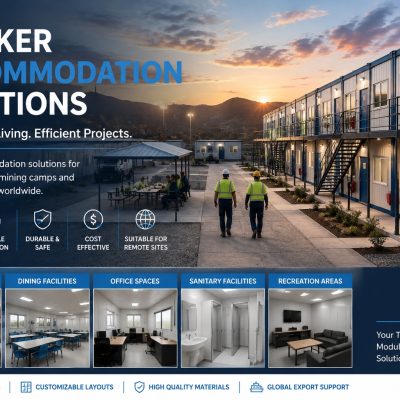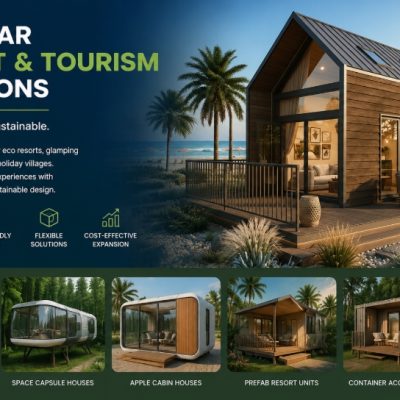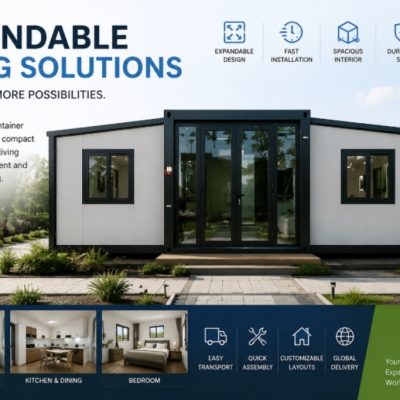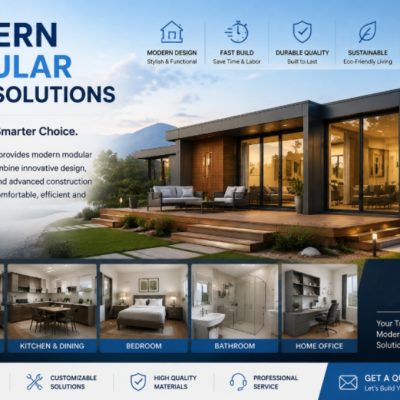

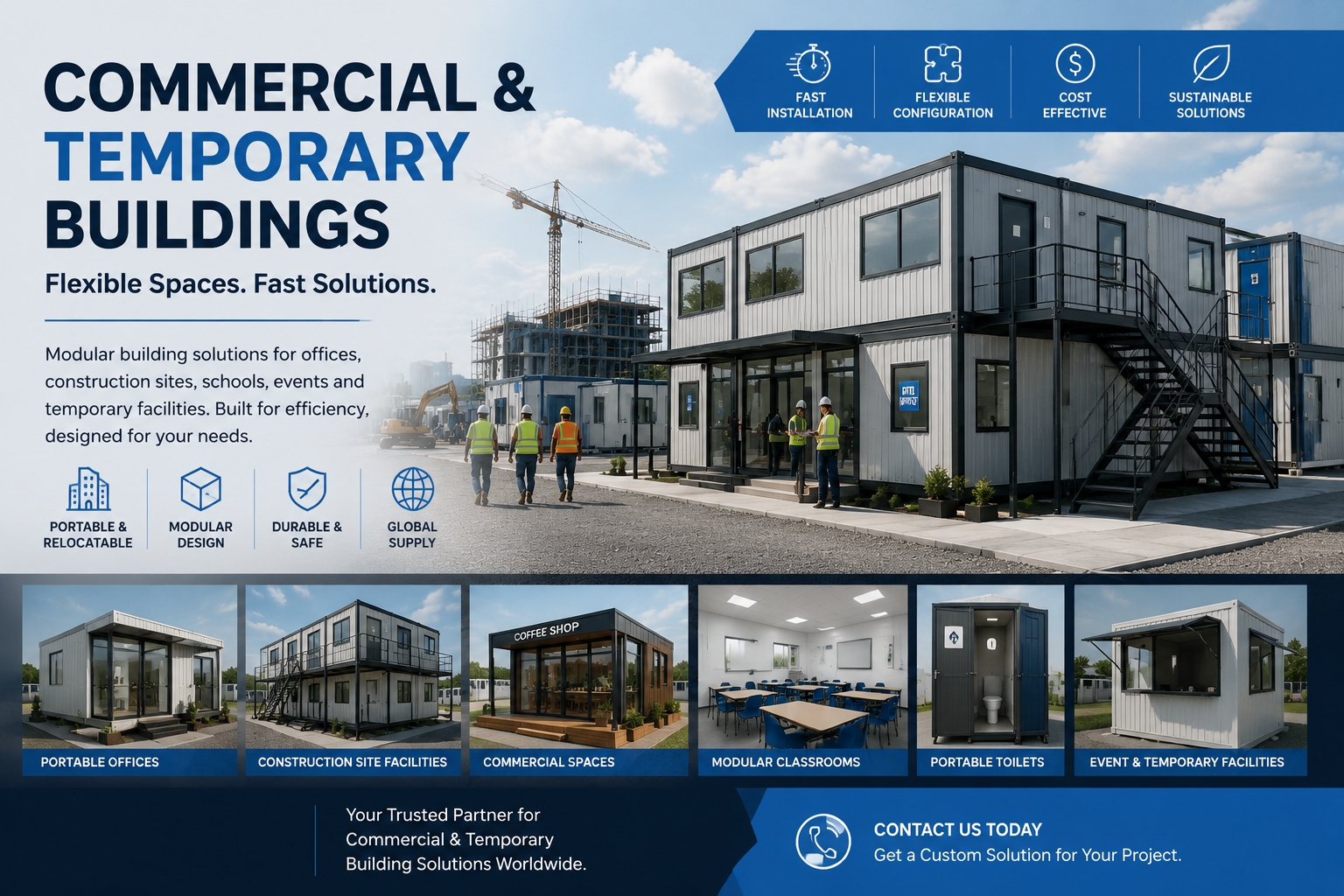
Expanding commercial operations or setting up a job site? This application guide details commercial and temporary modular buildings, including portable site offices, Flat Pack administrative complexes, modular classrooms, and portable sanitary units engineered for fast deployment.
Key Takeaways
- Accelerated Operational Readiness: Modular commercial structures condense construction schedules by up to 50% through concurrent off-site fabrication and on-site foundation prep, allowing businesses to launch operations months faster.
- High Structural Scalability & Relocation: Systems like Flat Pack and Detachable containers allow companies to expand layouts horizontally, stack up to 3 stories, or completely disassemble and relocate buildings to new sites as project phases finish.
- Complete Supply Scope Integrity: Factory production includes pre-engineered galvanized steel framing, insulated sandwich wall panels ($50\text{ mm}$ to $100\text{ mm}$ EPS, Rockwool, or PU), integrated electrical distribution grids, and commercial plumbing.
- Versatile Commercial Applications: Modular platforms seamlessly adapt to job-site administrative offices, temporary retail pop-ups, modular school classrooms, public facilities, and portable sanitary blocks.
What Are Commercial & Temporary Modular Buildings?
Commercial and temporary modular buildings are prefabricated structural systems manufactured off-site in controlled factory conditions and assembled on site to fulfill immediate or semi-permanent operational requirements.
Rather than committing capital and time to permanent brick-and-mortar development, commercial enterprises, civil contractors, and public institutions utilize modular structures to establish functional administrative, retail, and municipal facilities rapidly.
These modular systems serve across several primary commercial applications:
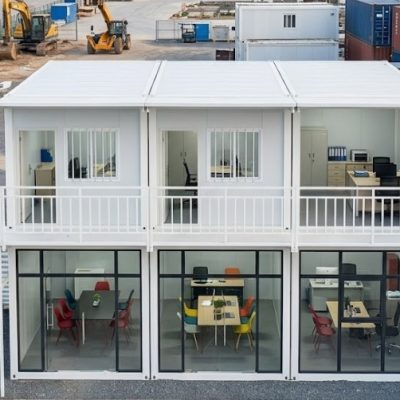
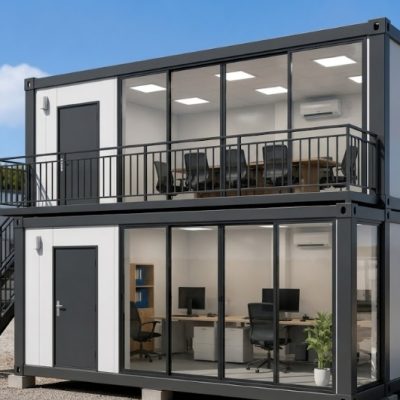
- Portable Job-Site Offices: Administrative centers, engineering hubs, meeting rooms, and contractor headquarters for construction and infrastructure projects.
- Commercial & Retail Outlets: Pop-up retail shops, customer service kiosks, exhibition booths, and temporary branch locations.
- Educational & Institutional Buildings: Auxiliary school classrooms, corporate training centers, community meeting halls, and administrative offices.
- Public & Temporary Facilities: Rapid-deployment disaster relief centers, ticketing pavilions, and heavy-duty portable restroom/shower blocks.
What Are the Key Applications of Commercial & Temporary Modular Buildings?
                        +-----------------------------------+
                        |  COMMERCIAL & TEMPORARY USES      |
                        +-----------------------------------+
                                          |
        +-----------------+---------------+---------------+-----------------+
        |                 |                               |                 |
        v                 v                               v                 v
+-----------------+ +-----------------+           +-----------------+ +-----------------+
| Portable Job-   | | Construction    |           | Commercial &    | | Educational &   |
| Site Offices    | | Facilities      |           | Retail Outlets  | | Event Spaces    |
+-----------------+ +-----------------+           +-----------------+ +-----------------+
| * Manager Hubs  | | * Security Posts|           | * Pop-Up Shops  | | * Modular Classrooms|
| * Conference    | | * Worker Canteens|          | * Kiosks        | | * Event Offices |
|   Rooms         | | * Tool Storage  |           | * Service Outlets| * Disaster Units |
| * Break Spaces  | | * Welfare Units |           | * Showrooms     | | * Portable Restrooms|
+-----------------+ +-----------------+           +-----------------+ +-----------------+
1. Portable Office Buildings & Corporate Workspaces
Industrial complexes, remote job sites, and fast-growing enterprises frequently require additional administrative space on tight timelines. Portable office structures deliver climate-controlled workspace without the extended development timelines of traditional construction.
- Primary Uses: Construction site management offices, executive meeting suites, project engineering hubs, remote operations centers, and corporate break rooms.
- Key Advantages: Turnkey electrical layout, integrated LED lighting, split-system HVAC prep, and customizable open-plan or multi-office configurations.
2. Construction Site & Infrastructure Support Facilities
Large-scale civil infrastructure, real estate, and industrial projects require temporary facilities to support daily worker operations and administrative oversight.
- Primary Uses: Site command offices, contractor conference rooms, entry gate security cabins, welfare canteens, and equipment storage units.
- Key Advantages: Fast field installation, stackable designs up to 3 stories to conserve tight urban site footprints, and high structural reusability across multiple project lifecycles.
3. Commercial Spaces & Retail Outlets
Modular building systems provide property owners and retail brands with adaptable spaces that reduce commercial launch times and capital risks.
- Primary Uses: Pop-up retail boutiques, coffee shops, customer service centers, event ticketing hubs, and brand showrooms.
- Key Advantages: Customizable exterior cladding options, large display window framing, modern interior wall finishes, and fast site placement.
4. Educational & Public Institutional Facilities
Schools, universities, and municipal bodies turn to modular buildings to manage student overflow, facility renovations, or sudden demographic shifts.
- Primary Uses: Modular school classrooms, corporate training suites, community centers, and municipal administrative offices.
- Key Advantages: Excellent acoustic damping via Rockwool insulation cores, healthy indoor air distribution, and compliance with regional commercial building safety codes.
5. Event Operations & Emergency Response Units
When rapid, temporary spatial capacity is required for public events or emergency management, modular structures provide immediate operational hubs.
- Primary Uses: Event management centers, medical triage quarters, security command posts, disaster relief shelters, and portable restroom/shower blocks.
- Key Advantages: Compact ocean/inland transit profiles, tool-free or rapid-bolt assembly, and immediate utility connectivity.
Which Modular Products Fit Your Commercial Application?
Selecting the appropriate modular platform depends on space requirements, structural mobility, and planned operational duration:
| Product Category | Framework & Core Materials | Transit & Packing Format | Scalability / Stacking | Best Operational Target |
| Portable Office Building | Galvanized steel chassis + composite wall panels | Assembled unit flatbed delivery or flat-pack bundle | Single-story or 2-story options | Job-site management hubs, executive field offices |
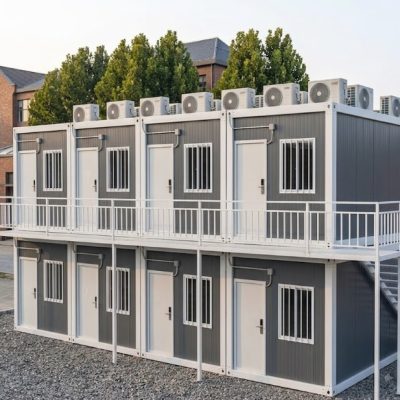
| Flat Pack Container Unit | Heavy galvanized steel frame + corner columns | 4 Units bundled equal one $20\text{ft}$ ISO frame | Stackable up to 3 stories high | High-density multi-unit office complexes, schools |
| Detachable Container Unit | Knocked-down bolted structural steel profiles | Loose bundled structural beams and wall panels | Stackable up to 2 stories high | Tight-access urban sites, rental fleets, relocatable hubs |
| Portable Sanitary Unit | Pre-plumbed steel frame + waterproof PVC floors | Turnkey assembled pod or flat-pack module | Single-story placement | Construction welfare blocks, public events, parks |
Why Choose Modular Systems for Commercial Construction?
1. Accelerated Revenue & Operational Timelines
Fabricating modular components off-site in parallel with ground civil preps cuts total construction schedules by 30% to 50%, enabling businesses to launch operations and capture revenue earlier.
2. Scalable Layouts & Complete Structural Mobility
Commercial modular buildings feature standardized corner fittings and interconnecting frame panels. Workspaces can be expanded by adding extra modules horizontally or vertically, or unbolted and moved to new job sites when project phases end.
3. Optimized Landed Procurement Costs
Knocked-down flat-pack and detachable modular systems pack tightly into standard $40\text{ft}$ High Cube shipping containers, drastically reducing international freight expenses per square meter of usable commercial space.
4. Durable, Climate-Controlled Interiors
Commercial modules incorporate galvanized steel structural frames, insulated core wall panels ($50\text{ mm}$ to $100\text{ mm}$ EPS, Rockwool, or Polyurethane), pre-wired breaker boxes, double-glazed Low-E windows, and heavy-duty commercial floor finishes.
What Factors Should Buyers Consider Before Purchasing Commercial Modular Buildings?
- Spatial Capacity & Layout Requirements: Determine required floor areas, room partitioning (private offices, conference rooms, open-plan desk zones), and sanitary compartment ratios based on daily worker headcount.
- Climate & Structural Load Ratings: Select wall panel insulation materials ($50\text{ mm}$ EPS for mild zones; $75\text{ mm}$ to $100\text{ mm}$ Rockwool or PU for extreme hot/cold zones) to meet local wind load, snow load, and thermal energy efficiency codes.
- Electrical & Sanitary Utility Standards: Verify local grid specifications ($110\text{V}/60\text{Hz}$ or $220\text{V}/50\text{Hz}$) along with pre-routed plumbing manifold specs for wet baths and break rooms.
- Foundation Prep & Crane Site Access: Ensure installation pads feature level concrete piers, strip footings, or gravel beds designed for floor loads, and verify site access for delivery flatbeds and cranes.
What Are the Frequently Asked Questions (FAQ)?
How quickly can a modular commercial office be installed on site?
A single-unit portable office can be positioned, unleveled, and connected to main power within 1 to 2 hours using a crane or forklift. Larger multi-unit, multi-story office complexes assembled from flat-pack modules typically require a few days to a week depending on total unit count.
Can modular commercial buildings be stacked or combined?
Yes. Flat Pack Container Buildings feature reinforced structural corner posts and heavy steel framing that allow them to be safely stacked up to 3 stories high. Interior partition walls can be omitted to create large open-plan conference rooms or multi-desk office zones.
How are fresh water, power, and waste networks connected?
Modules arrive pre-wired with distribution breaker panels, lighting, and outlets, and pre-plumbed to external manifold points. Licensed trade contractors connect site electrical feeds directly to the breaker panel and join water supply lines and waste discharge outlets to municipal utilities or septic tanks.
What is the expected lifespan of a commercial modular structure?
Commercial modular buildings constructed with hot-dip galvanized steel framing, baked powder coatings, and heavy-duty wall panels carry an operational lifespan of 15 to 20+ years, enduring multiple assemble-and-relocate cycles across different project sites.
How Can You Request Layout Drawings and Commercial Quotations?
Whether you require a single job-site office, a multi-story administrative complex, a modular school expansion, or portable sanitary facilities, our engineering team provides complete CAD floor plans, material spec sheets, and landed freight estimates.