
When planning a small resort, eco-retreat, or vacation-rental property, choosing the right accommodation unit is one of the most consequential decisions you will make. Among modular building options, two formats frequently come to the shortlist: modular cabins and expandable container houses.
While both offer alternatives to traditional on-site construction, they are built differently, transported differently, and create very different spatial experiences once installed. Choosing between them requires looking beyond promotional photographs or base prices to evaluate how each option aligns with your property, your guests, and your operational realities.
For a broader framework on layout and sizing when planning a small property, you may want to review our guide on planning a small modular resort. Otherwise, let’s examine how modular cabins and expandable container houses actually compare for resort development.
What Is the Difference Between a Modular Cabin and an Expandable Container House?
To make an informed choice, it helps to understand the fundamental characteristics of each building type. While actual designs vary by supplier, their commercial and structural profiles generally follow distinct patterns.
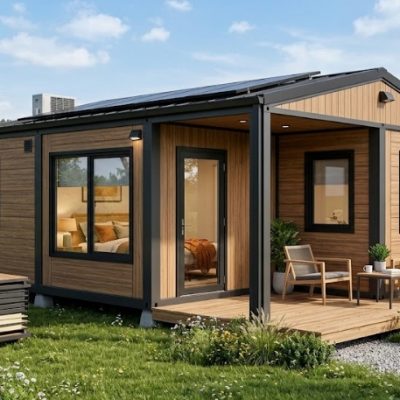
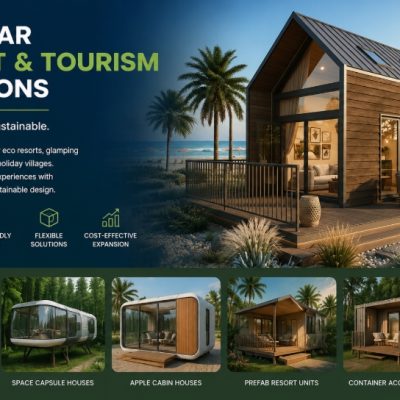
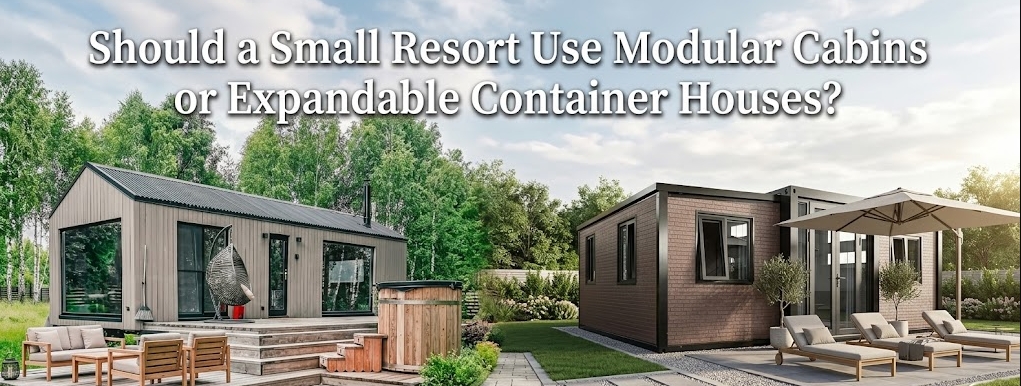
A Modular Cabin is typically designed around a traditional residential or lodge-like aesthetic. It often arrives at the site as a completed or semi-completed volumetric module, featuring pitched or skillion roofs, wood or composite exterior cladding, and fixed room layouts.
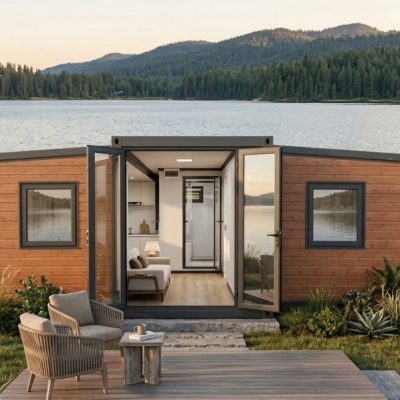
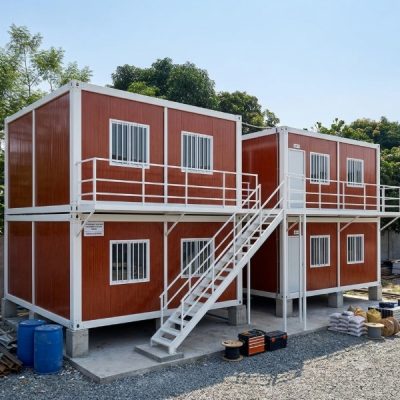
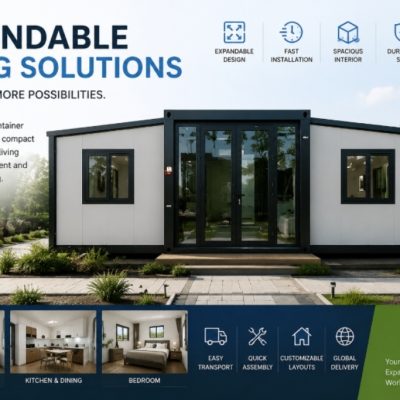
An Expandable Container House is engineered around a compact transport footprint—often packed into standard shipping container dimensions for efficient freight—which then unfolds or expands laterally at the destination to deploy a larger interior living area.
| Decision factor | Modular Cabin | Expandable Container House |
| Overall appearance | May suit cabin-style or design-led accommodation | Often follows a container-based modular form |
| Usable space | Depends on the supplied cabin model | Designed to expand beyond its transport configuration |
| Transport | Depends on the unit’s transport dimensions and packing | Compact transport configuration may be an advantage |
| Installation | May require lifting and positioning of a largely completed unit | Requires space and the correct method to expand and secure the unit |
| Customization | Depends on the available design and finish options | Depends on the model and available layout options |
| Main issue to confirm | Delivery access, finish, layout and site positioning | Expanded footprint, access, unloading and expansion space |
Buyers must verify actual product drawings and specifications rather than assuming a product label describes every detail of the interior fit-out or structural engineering.
When Does a Modular Cabin Make More Sense for a Small Resort?
A Modular Cabin is often worth considering when the resort concept relies heavily on its exterior appearance and relationship with the surrounding landscape.
This option frequently fits:
- Scenic or nature-oriented retreats where guest units need a warm, residential, or rustic character.
- Boutique properties where exterior architecture forms a core part of the brand identity and guest expectations.
- Locations prioritizing fixed layouts that require minimal on-site mechanical deployment.
When evaluating modular cabins, pay close attention to window placement relative to views, exterior cladding durability, bathroom and kitchenette plumbing rough-ins, and how the unit integrates with an outdoor deck or terrace.
When Does an Expandable Container House Make More Sense?
An Expandable Container House is typically considered when logistics, transport efficiency, and interior space optimization are the primary drivers.
This option may suit:
- Projects requiring a larger usable floor area from a relatively compact initial shipping footprint.
- Properties with repeatable accommodation layouts where standardized living, sleeping, and sanitation zones are pre-configured.
- Remote locations where minimizing freight volume per square meter of living space is a priority.
Before ordering an expandable model, buyers must carefully check folded versus expanded dimensions, structural hinge and locking mechanisms, weatherproofing seals along the expansion joints, and whether the supplied room configuration genuinely matches how guests will use the space. For a deeper dive into pre-order logistics, review these checks before ordering an expandable container house.
Which One Provides a Better Guest Experience?
Guest satisfaction relies on the complete living environment rather than the construction method.
- Spatial Feel: A well-designed modular cabin often provides higher ceilings, natural roof slopes, and traditional residential proportions that feel permanent and solid. An expandable container house maximizes square footage relative to transport size, though interior ceiling heights and corner columns are dictated by its folding framework.
- Comfort & Climate: Both systems can be insulated to a high standard, but thermal bridging, acoustic privacy between rooms, and HVAC placement must be confirmed in the supplier’s specification.
- Functionality: A cramped cabin with poor storage will underperform compared to an expandable unit with a clever, practical layout. Conversely, an expandable unit with awkward folding partition lines may disrupt the guest experience.
Match the unit’s actual interior layout to your target guests—whether they are couples staying for a weekend or families needing efficient storage and kitchen facilities.
Which One Is Easier to Deliver and Install?
Delivery and installation requirements differ significantly between the two systems and depend heavily on your specific land conditions.
- Modular Cabins arrive as rigid volumetric structures. While this means less assembly work on-site, their rigid dimensions can make transport challenging on narrow, winding rural access roads. Positioning them typically requires heavy lifting equipment, such as a crane, and adequate overhead clearance.
- Expandable Container Houses travel in a compact state, which can simplify long-distance hauling and initial road transport. However, they require sufficient clear space immediately adjacent to the final foundation pad for workers to unfold, level, and secure the expanding side wings.
Always distinguish between getting the building to your property boundary and maneuvering it safely to its exact final foundation.
How Does Site Access Affect the Choice?
Your physical terrain often makes the final decision for you. Consider these common scenarios:
- Narrow rural roads with sharp turns: An expandable container house in its compact shipping configuration may navigate tight corners more easily than a wide, rigid modular cabin.
- Sloping or uneven resort land: Both systems require engineered foundations, but a modular cabin’s rigid frame can sometimes interface more straightforwardly with elevated pier or stilt foundations common in eco-resorts.
- Restricted unloading space: If your site has dense trees, overhead power lines, or limited staging areas, check whether you have room to unfold an expanding unit or swing a crane boom for a fixed cabin.
How Much Does Each Option Cost?
Quotation structures vary widely across suppliers, making direct price comparisons complex. Costs are driven by building dimensions, interior finishes, insulation thickness, window glazing grades, bathroom fixtures, and electrical wiring standards.
Crucially, remember:
$$\text{Building Price} \neq \text{Delivered Building Cost} \neq \text{Total Resort Project Cost}$$
A lower base price for a basic container unit may be offset by higher on-site assembly, foundation, and finishing labor. Conversely, a higher initial cabin price may include more pre-finished interior surfaces, reducing on-site trade hours. Always request a clear scope of what is included (EXW, FOB, CIF, or DDP) and what is excluded.
What Costs Are Easy to Overlook?
Beyond the building quotation itself, successful deployment at a resort requires budgeting for several auxiliary project phases:
- Site clearing, leveling, and geotechnical preparation
- Foundation systems (concrete slabs, helical piles, or steel piers)
- Utility connections (water supply, wastewater treatment, electrical mains or solar setups)
- Inland freight, local trucking, and port handling
- Unloading, crane hire, and specialized installation crew labor
- External staircases, access walkways, and outdoor decking
- Landscaping, exterior lighting, and privacy screening
Can a Small Resort Use Both Modular Cabins and Expandable Container Houses?
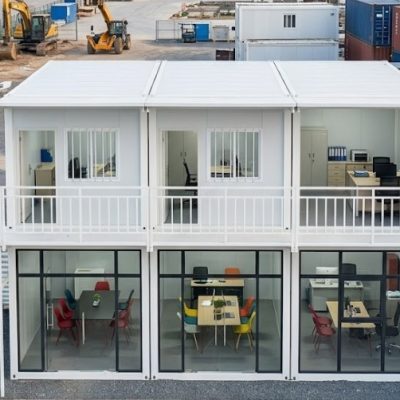
Yes, but only when driven by a clear functional requirement. For example, a resort might use modular cabins for prime cliffside guest suites where aesthetic integration is paramount, while utilizing expandable container houses for staff accommodation, reception offices, or multi-bed family units where space efficiency and rapid deployment matter most.
Combining systems introduces additional complexity in architectural consistency, maintenance parts inventory, and supplier coordination. Only adopt a mixed approach if it solves a genuine operational need.
What Should You Confirm Before Requesting a Quotation?
To secure accurate, comparable proposals from suppliers, prepare the following details before reaching out:
- Project Context: Geographic location, target opening date, and intended guest profile (e.g., eco-tourists, luxury seekers, digital nomads).
- Site Conditions: Site layout sketch, road access limitations, slope details, and available staging space.
- Accommodation Specs: Required number of units, preferred bedroom/bathroom count, minimum indoor floor area, and deck preferences.
- Procurement Scope: Clarify whether you need turnkey finishing or basic shell units, and specify your desired shipping and installation support level.
How Should You Make the Final Decision?
Weigh your choice based on project fit rather than generalized assumptions:
- Prioritize Modular Cabins if your resort concept demands a distinct architectural cabin style, your site permits heavy transport and crane positioning, and the interior layout directly serves your target guest experience.
- Prioritize Expandable Container Houses if transport compactness is critical, your site layout accommodates lateral unfolding, and the standardized floor plan efficiently meets your functional requirements.
If neither option aligns perfectly with your land and guest expectations, explore alternative modular configurations rather than forcing an unsuitable building onto your property.
How Xinen Modular House Helps Small Resort Buyers Compare Options
Xinen Modular House operates as a modular building supplier and project solutions provider. We do not manufacture buildings locally or act as an on-site EPC contractor, but we help international buyers navigate the procurement process.
We assist with:
- Clarifying resort accommodation requirements and spatial layouts
- Comparing Modular Cabin and Expandable Container House configurations
- Reviewing supplier product specifications and engineering drawings
- Comparing supplier quotations and identifying missing scope items
- Evaluating transport, logistics, and site-access constraints
- Organizing project information and coordinating supplier communication before ordering
Key Takeaways
- Neither modular cabins nor expandable container houses are universally superior for every resort.
- The guest experience depends entirely on the complete interior layout and specification.
- Modular cabins suit projects where exterior form and landscape integration are central.
- Expandable container houses suit projects prioritizing transport efficiency and deployed floor area.
- Site access and installation logistics frequently dictate the final building choice.
- Building purchase price and total installed resort cost are distinct financial figures.
- Quotations must be evaluated strictly against their included scope and specifications.
- The building should serve the project’s operational goals, not the other way around.
FAQ
What is the difference between a Modular Cabin and an Expandable Container House?
A modular cabin is generally delivered as a rigid, volumetric structure designed around a traditional architectural cabin style. An expandable container house travels in a compact transport configuration and unfolds laterally on-site to increase its usable indoor area.
Which is better for a small resort?
Neither is universally better. The right choice depends on your resort concept, guest expectations, site access constraints, and total project budget.
Are Modular Cabins suitable for vacation rentals?
Yes. Their residential appearance and solid construction make them popular for boutique retreats and high-end vacation rentals, provided the interior layout matches guest needs.
Can Expandable Container Houses be used as resort accommodation?
Yes, many resorts use them successfully for guest rooms, provided the model offers durable weatherproofing, proper insulation, and a comfortable interior layout.
Which option offers more usable indoor space?
Expandable container houses are specifically designed to expand beyond their transport footprint, often delivering a larger indoor floor area relative to their shipping size than fixed cabins.
Which is easier to transport to a remote property?
Expandable container houses often have an advantage in long-distance freight because their compact folded dimensions reduce shipping volume, though final local road conditions must still be evaluated.
Does installation require a crane?
Many modular cabins require a crane or heavy lifting equipment due to their rigid volumetric weight. Some expandable units may require lifting equipment or specialized positioning support depending on the model.
Which option costs less?
Base product prices vary widely by supplier, specification, and finish level. Furthermore, transport, foundation, and on-site assembly costs mean total project expenses often differ from base unit quotes.
Can a resort use both types of modular buildings?
Yes, properties sometimes use cabins for premium guest suites and expandable containers for functional support units or staff housing, provided the operational complexity is managed.
What should I send a supplier before requesting a quotation?
Provide your project location, site layout or access details, required number of units, preferred room layout, target schedule, and whether you need standard shell units or fully finished interiors.