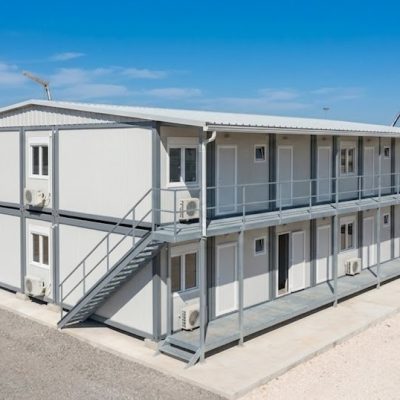

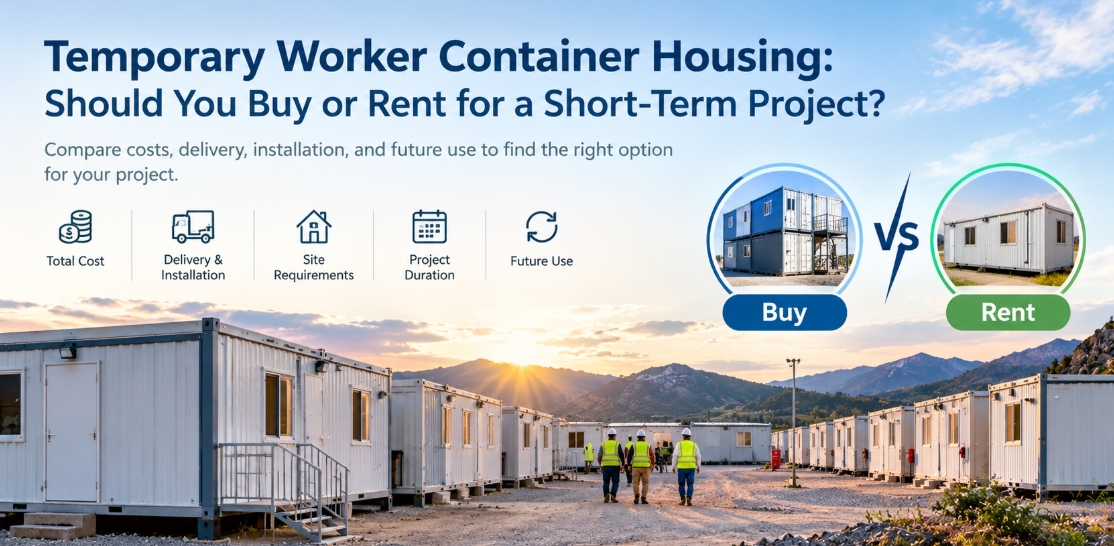
A construction project needs accommodation for 15 workers for six months. The site is outside the nearest town, local rental options are limited, and the project schedule could change by several weeks.
Should the company purchase container accommodation and manage it after the project, or rent units and return them when the work is finished?
There is no automatic answer. Renting avoids some ownership responsibilities, but delivery, collection, and minimum rental periods can make it less attractive than expected. Buying requires a larger initial commitment, yet may make sense when the units can be used again at another site.
For temporary worker container housing, the decision should be based on the total cost of use, availability, site requirements, and what happens to the accommodation when the project ends.
Is Buying or Renting Better for a Short-Term Project?
Both options can work. The more suitable choice depends on how long accommodation is needed, where the project is located, what configuration workers require, and whether the units have a future use.
| Project situation | Option worth evaluating | Main consideration |
|---|---|---|
| A clearly defined project with a reliable local rental supply | Renting | Rental term, delivery, collection, and return conditions |
| A remote project with few suitable rental options | Buying and renting should both be assessed | Transport cost, availability, and delivery schedule |
| A project that may move to another site | Buying may be worth considering | Whether the units can be relocated economically |
| A project requiring a specific accommodation layout | Compare available rental stock with purchased configurations | Whether existing rental units meet the requirements |
| A project with an uncertain end date | Compare flexible rental terms with ownership costs | Extension charges, storage, and future use |
| A seasonal operation that repeats each year | Buying may deserve closer evaluation | Storage, maintenance, and reuse between operating periods |
These are starting points, not rules. A remote location does not automatically make buying cheaper, and a project lasting only a few months does not automatically make renting better.
The first step is to establish the actual accommodation requirement. How many people need to stay on site? Is the accommodation required every day or only during certain shifts? Are the units needed for sleeping alone, or must they also provide bathrooms, showers, changing space, or other facilities?
Once the requirement is clear, the financial comparison becomes more meaningful.
1. What Does Buying Temporary Worker Container Housing Really Cost?
When purchasing accommodation, the quoted unit price is only one part of the expenditure.
The buyer must consider the cost of obtaining the units, preparing the site, making them usable, maintaining them during the project, and dealing with them afterward.
The initial purchase and delivery costs
A purchase quotation should identify the supplied configuration and the items included in the price.
For example, two quotations for worker accommodation may differ in insulation, internal partitions, electrical fittings, bathroom arrangements, doors, windows, and other included equipment. Comparing the headline prices alone may therefore produce a misleading result.
For an overseas project, the following costs may also need to be considered:
- International freight, insurance, port handling, customs clearance, and applicable import charges.
- Local transportation from the port or supplier to the project site.
- Unloading equipment and lifting arrangements.
- Site levelling, foundations or supports, and drainage preparation.
- Assembly, installation, and connections for electricity, water, and wastewater.
- Local labour, inspection, and other project-specific requirements.
Not every project incurs every expense, and some suppliers may include particular services in their quotations. Ask for a clear scope breakdown so that you can identify what remains the buyer’s responsibility.
Ongoing ownership costs
Purchasing means taking responsibility for the units beyond the initial delivery.
Depending on the arrangement, ongoing costs may include cleaning, repairs, replacement parts, inspections, insurance, and maintenance of installed equipment.
Climate also matters. A unit used in a hot, humid environment may need different insulation, ventilation, corrosion protection, or air-conditioning provisions from one used in a cool, dry location.
The required specification should reflect the destination conditions rather than simply selecting the least expensive available configuration.
What will the units be worth afterward?
A purchased unit may be useful on another project, but that future value should not be taken for granted.
A second site may have different access constraints, climate requirements, dimensions, utility arrangements, or accommodation standards. The unit may need repairs, storage, transportation, or modifications before it can be used again.
Resale value is equally uncertain. It depends on the local market, the unit’s condition, its configuration, and the cost of moving it to another buyer.
If the purchase decision only works financially when the units can be sold at a particular price, treat that resale value as an assumption to verify rather than guaranteed income.
2. What Does Renting Temporary Worker Accommodation Really Cost?
Renting can reduce the need to own, store, and eventually dispose of accommodation. However, the contract must be evaluated as a complete package.
Rental charges and contract terms
Check whether the supplier charges by the day, week, month, or another billing period. Establish the minimum rental period, payment terms, deposit, extension rules, and conditions for early return.
A project may finish earlier than planned, or it may continue beyond its original deadline. Either situation can affect the final cost.
Questions to ask include:
- Is the required configuration available for the planned dates?
- Does the rental period begin at delivery, installation, or another agreed date?
- Can the rental be extended if the project is delayed?
- Who pays for damage beyond normal use?
- Are maintenance and repairs included?
- What condition must the units be in when returned?
The answers should be confirmed in the rental agreement rather than assumed from a general quotation.
Delivery and collection
For a remote site, transport can be a substantial part of the rental arrangement.
The rental provider may charge separately for delivery, unloading, positioning, installation, and collection. A site that is difficult to reach may also require additional handling or special transport arrangements.
Ask whether the quotation includes the full journey to the actual project location. A rental price that appears attractive near the supplier’s depot may be less competitive once transport and removal are included.
Limited availability and unsuitable configurations
Renting is only practical when the required units are available where and when they are needed.
Local providers may have units available, but they may not match the required layout, insulation, bathroom configuration, occupancy needs, or delivery schedule.
If units must be sourced from a distant location, transport and coordination may reduce the practical advantage of renting.
A useful comparison should therefore use an actual rental proposal and an actual purchase quotation—not an estimated rental price compared with a confirmed purchase price.
3. How Can You Compare Buying and Renting Fairly?
The fairest approach is to calculate the cost of meeting the same accommodation requirement over the same period.
For purchasing, use this planning formula:
Total purchase cost = Purchase price + Delivery and installation + Required site connections + Ownership and maintenance costs + End-of-project costs − Realistic resale or reuse value
For renting:
Total rental cost = Rental charges for the actual period + Delivery and collection + Installation and required site connections + Other applicable contract charges
These are simplified comparison frameworks, not complete accounting models. Use the actual scope of each quotation and avoid counting costs twice when services are already included.
Build a like-for-like comparison
Suppose your project needs accommodation for 15 people over a defined six-month period.
Before comparing prices, establish the same requirements for both options:
- The number of people to be accommodated and the layout required.
- The expected delivery date and accommodation period.
- The required insulation, ventilation, and climate-control provisions.
- Whether bathrooms, showers, or other facilities are needed.
- The site preparation and utility connections required.
- Who is responsible for installation, maintenance, and removal.
- What happens if the project finishes early or runs late.
Then obtain a purchase quotation and a rental quotation based on these same requirements.
A comparison table can make omissions easier to spot.
| Cost or responsibility | Purchase | Rental |
|---|---|---|
| Initial unit cost | Purchase price | Deposit and applicable initial charges |
| Transport to site | Confirm included freight and local delivery | Confirm delivery fee and any special handling |
| Installation and connections | Confirm the buyer’s and supplier’s responsibilities | Confirm the rental provider’s scope and extra charges |
| Maintenance during use | Owner’s responsibility, subject to agreed service arrangements | Depends on the rental contract |
| Project extension | Continued ownership costs and use of the units | Possible additional rental charges |
| After the project | Reuse, storage, resale, relocation, or disposal | Collection, return condition, and possible damage charges |
There is no universal number of months at which buying becomes cheaper than renting. The result depends on local rental availability, purchase and transport costs, the project schedule, maintenance, and the realistic value of future use.
If a purchase only becomes attractive after assuming several future projects, test whether those projects are reasonably likely and whether they can use the same configuration.
4. What Happens When the Project Ends?
The end of the project is one of the most important differences between the two options.
It should be considered before ordering, not after the workers have left and the site needs to be cleared.
If you purchase the units
Start by identifying a credible next use.
Can the units move to another project owned by the same company? Will the next location accept the dimensions and layout? Can local transport and installation be arranged within the next project’s schedule?
For reusable systems, confirm how they must be disassembled, inspected, packed, transported, and reassembled. Some designs require more labour or equipment for relocation than others.
Storage is another consideration. Purchased units may sit unused between projects, and their condition may deteriorate if they are stored or maintained poorly.
The potential value of reuse is strongest when the next deployment is reasonably predictable—not simply because relocation is technically possible.
If you rent the units
Rental usually makes the return process part of the contract.
Confirm who arranges collection, who disconnects utilities, and whether the buyer must remove foundations, restore the site, or prepare the units for transport.
Check whether there are charges for late returns, damage, cleaning, or extensions. If the project schedule is uncertain, flexible contract terms may be worth more than a small difference in the headline rental rate.
A rental agreement should make clear what happens when the project changes—not only what happens when everything finishes on time.
5. Does the Type of Container Accommodation Affect the Decision?
Yes. Product configuration affects transport, installation, available interior space, and potential future use. However, no single design is automatically the best choice for every temporary worker accommodation project.
Expandable Container House
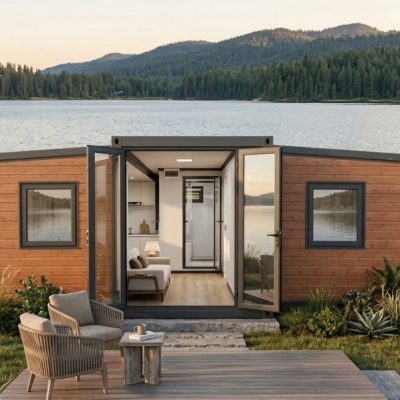
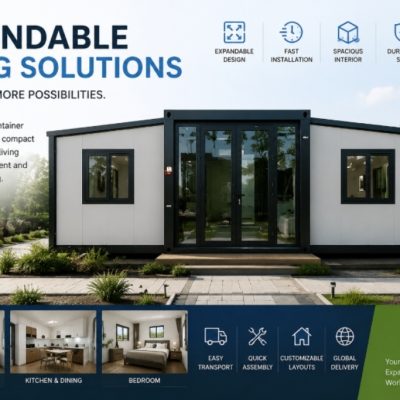
An expandable container house can be worth considering when a compact transport configuration needs to provide a larger usable floor area after deployment.
Before ordering, check the unit’s transport dimensions, opened dimensions, site access, lifting requirements, and the space needed to unfold its sections. The intended layout must also suit the number of occupants and the required facilities.
Do not assume that a compact delivery format removes the need for suitable access, site preparation, or installation planning.
Flat Pack Container House
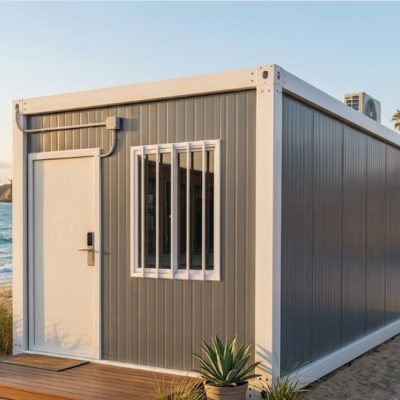
A flat pack container house may be suitable when several units need to be transported efficiently and assembled into a planned accommodation layout.
This configuration can be worth evaluating for projects that require multiple rooms or separate accommodation and welfare facilities. However, the buyer must account for assembly labour, equipment, installation time, and the site space needed during assembly.
Where a project is short, the time and expense required to assemble and later dismantle the system should be included in the comparison.
Detachable Container House
A detachable container house may be worth evaluating where disassembly, storage, or relocation is an important part of the project plan.
Confirm the actual connection system, disassembly procedure, labour requirements, and condition of components after repeated use. A building that can be disassembled is not necessarily economical to relocate frequently.
Transport arrangements and the next site’s requirements still determine whether reuse makes practical sense.
Standard container accommodation
Other modular accommodation configurations may also suit the project. The right choice depends on the available space, required layout, local transport arrangements, climate, site conditions, and the intended period of use.
For a more detailed overview of product types and purchasing considerations, see the Container House Buying Guide.
6. What Should You Check Before Ordering Temporary Worker Housing?
Whether you plan to buy or rent, define the project requirements before requesting quotations. This makes supplier responses easier to compare and reduces the risk of receiving prices for different specifications.
Confirm the accommodation requirement
Prepare the following information:
- Project location: Country, city or region, and exact delivery site where available.
- Worker numbers: The expected occupancy and number of units required.
- Project period: Planned start date, expected end date, and likelihood of an extension.
- Room arrangement: Sleeping layout, storage, privacy, and circulation requirements.
- Climate: Expected temperatures, humidity, rainfall, and the need for insulation, ventilation, or air conditioning.
- Facilities: Whether bathrooms, showers, laundry, dining, changing, or office space are needed.
Do not determine capacity only by counting beds. The arrangement must leave adequate usable space and provide the facilities required by the relevant rules and intended use.
Check site access and services
Before selecting a product, confirm the access route for delivery vehicles and the method for unloading and positioning the units.
Check whether the site has suitable ground conditions and support arrangements. Identify the availability of electricity, potable water, wastewater disposal, and any other required services.
If the location is remote, establish whether local contractors, equipment, replacement parts, and maintenance support will be available.
Agree on responsibilities in writing
Ask the supplier or rental provider to identify what is included in the price and who is responsible for each remaining task.
This should cover transport, unloading, installation, site connections, maintenance, repairs, removal, and any required documentation.
For purchased units, also confirm packaging, delivery arrangements, product specifications, and installation instructions. For rented units, confirm availability, contract duration, service responsibilities, return requirements, and extension terms.
For more detail on preparing and comparing container accommodation orders, see the Container House Buying Guide.
7. When Is Buying More Practical?
Buying deserves closer consideration when the units have a credible future use, suitable rental alternatives are unavailable, or the project requires a configuration that cannot readily be obtained locally.
It may also be appropriate when the organisation expects repeated deployments and can manage transport, maintenance, storage, and installation between projects.
Before proceeding, calculate the complete ownership cost and test the assumptions about future reuse. If the purchase only makes sense with an uncertain resale price or an unconfirmed next project, the financial case may be weaker than it appears.
8. When Is Renting More Practical?
Renting may be appropriate when the project has a defined duration, suitable local units are available, and the business does not want to retain responsibility for the accommodation afterward.
It can also suit organisations that need temporary capacity without adding assets to their inventory.
However, the rental agreement must fit the actual site and programme. Long-distance delivery, limited availability, minimum rental periods, expensive collection, or inflexible return dates can change the result.
A short rental period is helpful, but it is not enough on its own to establish that renting is the better option.
How Xinen Modular House Can Help You Compare Options
Xinen Modular House is a modular building product supplier and project solutions provider. We help buyers clarify their accommodation requirements, compare relevant product configurations and supplier quotations, identify scope gaps, and review delivery and installation considerations before ordering.
For temporary worker container housing, the useful starting point is not simply the number of containers. It is the project location, expected occupancy, accommodation period, required facilities, site access, and plans for the units after the project.
Based on these details, suitable configurations can be assessed alongside their transport and site requirements. Buyers should also compare actual local rental options where available, since rental availability and terms vary by destination.
To discuss a project, provide your destination country, approximate number of workers, required number of units, expected project duration, and intended use. Include any available site information or accommodation layout requirements.
This makes it easier to assess which product options deserve further comparison and which costs or responsibilities need clarification before a purchasing decision is made.
Key Takeaways
- A short project does not automatically make renting the better choice. Compare both options using the same accommodation requirements and project period.
- The purchase price and monthly rental rate do not represent the complete cost. Include delivery, installation, connections, maintenance, and end-of-project responsibilities.
- Buying becomes more attractive when future use is realistic and ownership costs can be managed.
- Renting becomes more attractive when suitable units are available locally and contract terms match the project’s schedule.
- Product configuration, transport access, climate, utilities, and local requirements matter regardless of how the units are acquired.
- Confirm the complete scope in writing before placing an order or signing a rental agreement.
Frequently Asked Questions
1. Is it cheaper to buy or rent temporary worker container housing?
Neither option is always cheaper. Buying involves the purchase price, delivery, installation, maintenance, and end-of-project costs, offset where appropriate by realistic resale or reuse value. Renting involves rental charges, delivery and collection, installation, and any additional contract fees. Compare actual quotations for the same project period and configuration.
2. Is renting container accommodation practical for a project lasting only a few months?
It can be practical when suitable units are locally available and the rental term, delivery schedule, and return conditions fit the project. Minimum rental periods, transport charges, or limited availability can make renting less attractive. Check the complete quotation rather than the monthly rate alone.
3. Can purchased worker accommodation containers be reused at another site?
Potentially, yes. Reuse depends on the building system, its condition, transport and disassembly requirements, access at the next location, and whether the layout meets the new project’s needs. Confirm these factors before assigning a financial value to future reuse.
4. What costs are often overlooked when buying temporary container housing?
Commonly overlooked items include local delivery, unloading equipment, foundations or supports, utility connections, installation labour, maintenance, storage, relocation, and final site clearance. For imported units, port handling, customs charges, and local transport may also apply. Ask suppliers to identify all exclusions.
5. Can expandable or flat pack container houses be rented?
Availability depends on the destination market and individual rental providers. Some locations may offer suitable modular accommodation for rent, while others may have limited choices or only standard units. Confirm the available product configuration, delivery arrangements, installation scope, and contract terms before deciding.
6. What information should I provide when requesting a temporary worker accommodation quotation?
Provide the destination country and site location, number of workers, number of units, project duration, required sleeping arrangement and facilities, climate conditions, delivery date, and available site-access information. Also state whether you are considering purchase, rental, or both. These details help suppliers assess the scope more accurately.